
I have a small confession. When a client walks us through her kitchen, coffee in hand, and asks what we should put just outside the back door of her Colorado home, I usually already know my answer. Outdoor porcelain tile.
It does something concrete pavers and natural stone can’t do on their own. It lets the floor you chose for inside continue out onto your patio or around your pool, so the two spaces read as one.
Here’s the homeowner version, not the spec sheet. What outdoor porcelain tile is, why it looks so good next to wood and metal and stone, how it holds up to a Colorado winter, and why it’s often not the splurge you’d expect. I’ll reference the Mirage EVO outdoor collection throughout, since it’s one of the porcelain lines we install most often at Summit Outdoor Living. (If I’m being honest, it’s my favorite child and this isn’t sponsored).
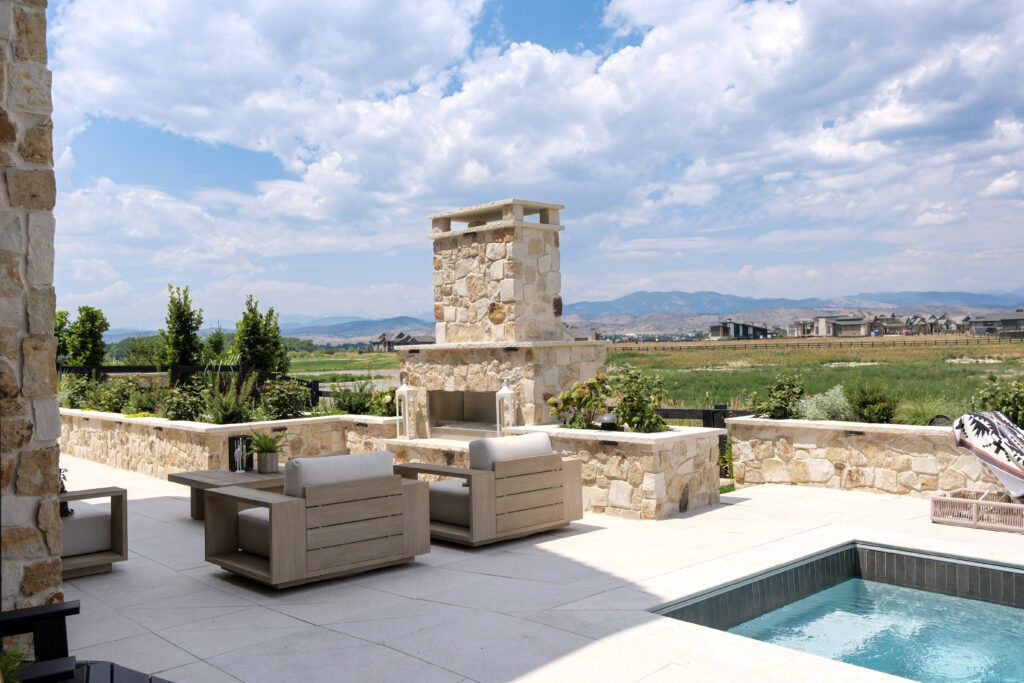
What Is Outdoor Porcelain Tile, Really?
Outdoor porcelain tile (you’ll also hear it called porcelain pavers) is a dense, kiln-fired porcelain made much thicker than the tile in your bathroom. The Mirage EVO_2/E collection is 20mm thick, about 3/4 of an inch, and was the first porcelain of its kind sold as a complete outdoor system. That thickness is what lets it handle foot traffic, furniture and freeze-thaw cycles outdoors.
What that means for you:
- It barely absorbs water. Porcelain is nearly impervious, so water has nowhere to hide and freeze inside the tile. That’s a big deal for an outdoor tile patio in Colorado.
- It’s frost, impact and thermal shock resistant. It handles a cold morning and a hot afternoon without cracking.
- It’s slip resistant. Outdoor finishes are textured for grip, which matters on a porcelain pool deck with wet feet and kids running.
- The color goes all the way through and doesn’t fade. No chalky, sun-bleached look in year five.
- It never needs sealing. Stains like red wine, grease and sunscreen wipe off.
- Italian Craftsmanship.
Why Choose Porcelain Tile Over Concrete Pavers or Natural Stone?
We install concrete pavers and natural stone all the time, and both have their place. Porcelain is different in three ways.
It speaks the same language as your interior. Most of us chose our indoor floors carefully. Maybe it’s a warm oak, a soft limestone look or a quiet concrete gray. Concrete pavers are made for the outdoors, so they rarely match what’s inside. Porcelain is the one material that lives happily in both places. Mirage designs many of its looks in coordinated indoor and outdoor versions, so the tile in your great room can share a color, a texture and even a size with the tile on your patio. Same look, two different jobs.
It gives you the natural stone look without the natural stone homework. Limestone and sandstone are timeless, but they’re porous. They need sealing, they can etch and stain, and every slab is a bit of a surprise. Porcelain gives you a stone, wood or concrete look with a uniform finish from piece to piece, and no sealing schedule to keep up with.
It’s crisp, large and calm. Big formats like 24″ x 24″ and 24″ x 48″ mean fewer joints, and fewer joints mean a cleaner, calmer surface. Not to mention the colors complement many current interior and exterior choices.
Carrying the Indoors Out
Picture a kitchen floor in a pale, wood-look porcelain. The bifold door opens, and the same planks continue across a covered patio, around an outdoor kitchen and over to a fire feature. Your eye doesn’t stop at the threshold, so both spaces feel bigger.
Matching trim pieces help too. Mirage makes pool coping, step treads and bullnose edges in the same 20mm material, so steps and edges match the field tile. That’s what makes an indoor outdoor flooring design look intentional, not pieced together.
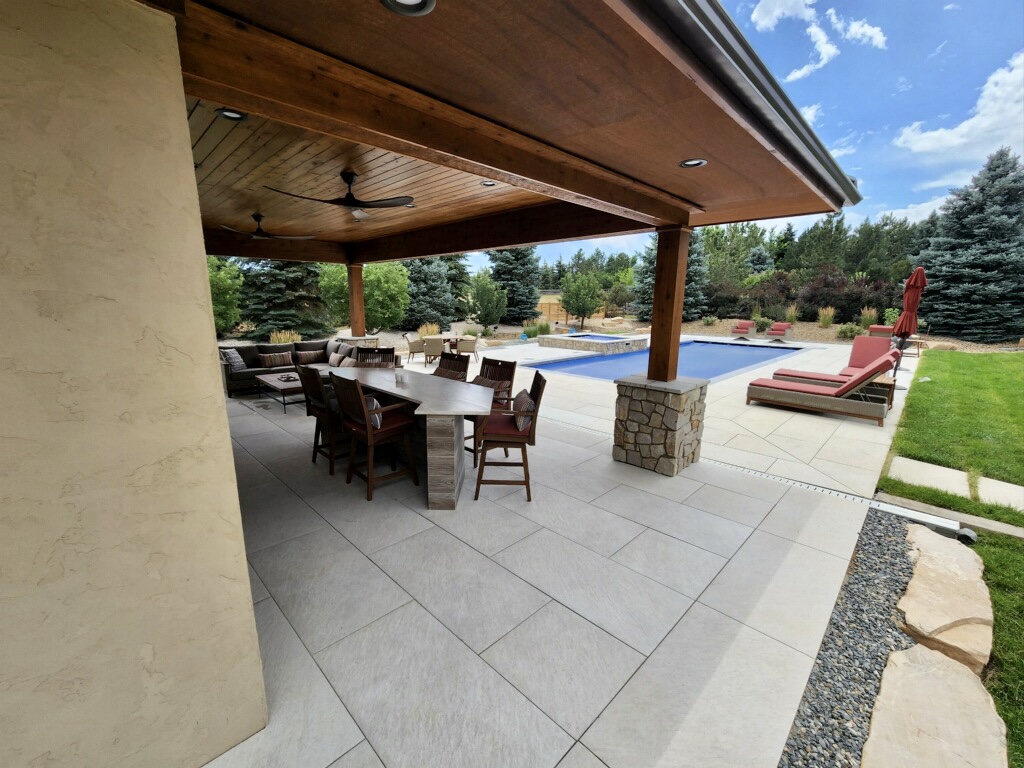
How Porcelain Tile Plays With Other Materials
Porcelain works well next to other materials because its surface is consistent and quiet. It comes in stone, wood and concrete looks, so it’s easy to coordinate with what you already have.
With concrete pavers. A layout we design often is porcelain laid as the body of the main patio, with concrete pavers as a border or on the walkways and driveway. The tile feels elevated, the pavers feel grounded, and the change in material helps define each area. It also puts more of the budget where you spend the most time.
With natural stone. Rough stone next to smooth creamy porcelain adds texture. A stone wall, boulder steps or a flagstone path beside a porcelain patio makes the space feel more natural and settled. Keep the colors close and the contrast comes from texture alone.
With metals. Black steel pergolas, Corten planters and fire pits and stainless outdoor kitchens pair well with porcelain because they all have clean lines. A concrete look tile with black steel feels modern. A warm stone look tile with bronze accents feels softer and more traditional.
With wood. Cedar ceilings, teak furniture and slat fences add warmth to a porcelain patio. If you like the look of a wood deck but not the staining and upkeep, wood look porcelain gives you the plank look underfoot, and real wood can stay overhead and in the furniture.
Done well, these combinations make a backyard feel like a finished room, with a floor, walls and a ceiling, instead of a patch of hardscape stuck out back.
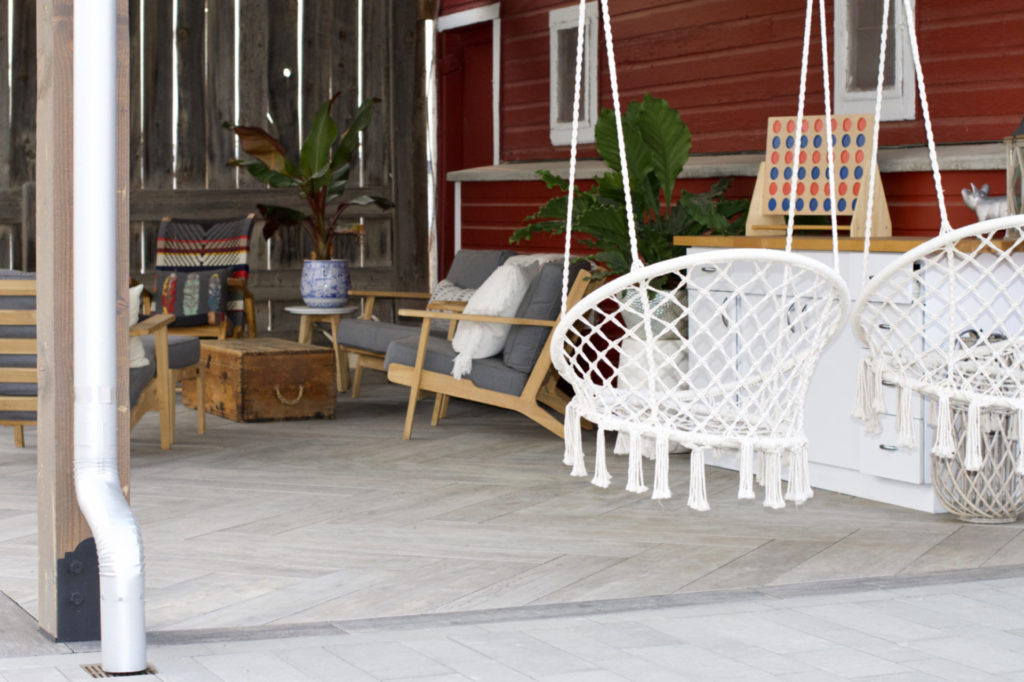
Is Outdoor Porcelain Tile Expensive? Not Always.
It’s one of the most common questions we get. It depends on how you value engineer it.
- It costs less than a lot of natural stone. Limestone, and premium finished flagstone can run well above porcelain once you add the cutting, honing, and waste that come with natural material.
- There’s no sealing. Natural stone and many concrete surfaces ask for sealer every few years. Porcelain doesn’t.
- It’s light. A 24″ x 24″ Mirage EVO slab weighs about 37 pounds. That means easier handling, and on some projects it opens up installation methods that save time on site. This is crucial in an area where space or access is limited.
- Large formats install efficiently. Bigger pieces mean fewer cuts and less labor time.
- It lasts. A surface that doesn’t fade, stain or need replacing saves money over time.
The honest answer is that your total depends on the size of the space, the base it needs and the installation method (more on that next). We can price your yard side by side with pavers and stone so you can compare.
Where Outdoor Porcelain Tile Shines
Where we use it most:
- Patios and covered porches. Especially where a patio meets a kitchen or living room door.
- Pool decks and plunge pool surrounds. Slip resistant, cool toned options, matching pool coping and no sealer to wear off around the water.
- Outdoor kitchens and dining areas. Grease, BBQ sauce and spilled wine wipe right up.
- Steps and entries. Step treads and bullnose pieces give stairs a finished, built-in look.
- Walkways and garden paths. Large slabs set in gravel or grass make a beautiful, modern stepping stone path.
- Fire feature lounges. Porcelain is fire proof, so it’s a natural fit around fire pits and fireplaces.
- Rooftop decks and balconies. Raised pedestal systems keep the weight down and hide drainage underneath.
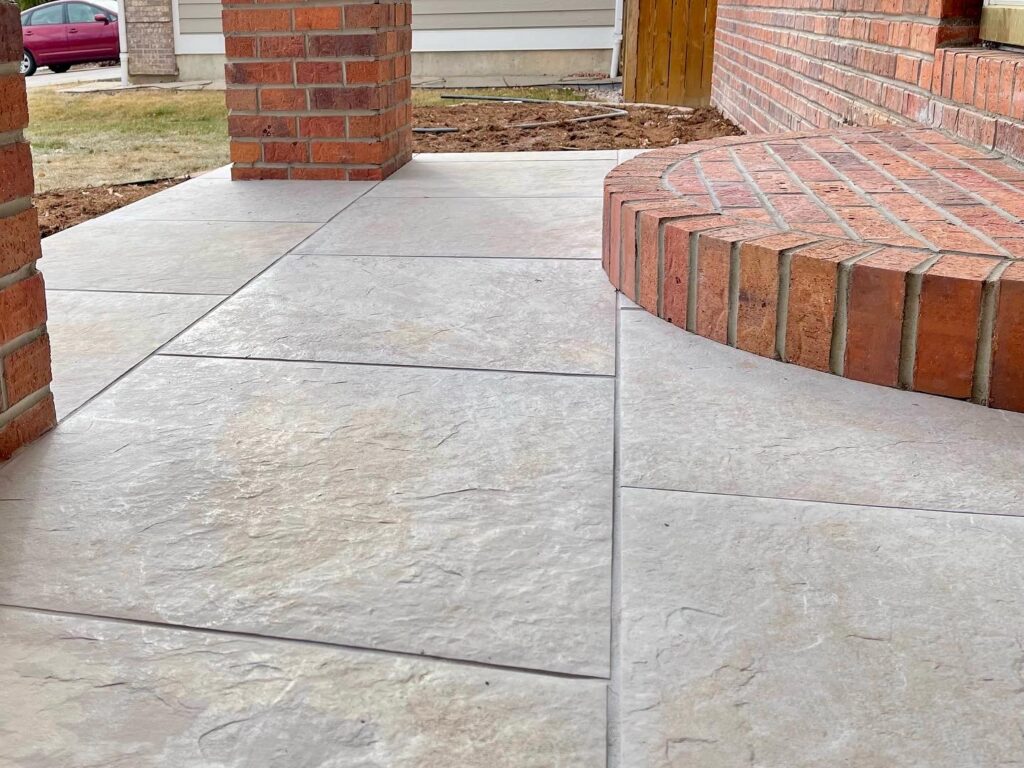
- An Overlay. An outdated or cracked concrete patio or front porch can be overlayed with tile depending on the existing site conditions without having to fully remove the concrete first.
How We Install Outdoor Porcelain Tile for Colorado’s Freeze-Thaw Cycles
The tile itself is tough. What really decides how it looks in ten years is what’s underneath it. Here in Northern Colorado, water seeps into the ground, freezes, expands, thaws and does it all over again, many times each winter. Any outdoor surface that traps water underneath it will eventually heave, crack or shift.
So our whole approach comes down to one idea: give water a way out. We use three installation methods, and we pick the right one for your space instead of forcing one method onto every yard.
1. Trass Mortar Set
Trass is a natural volcanic ash that’s blended into a special bedding mortar. It’s a long-standing method in Europe for setting stone and porcelain outdoors. A trass mortar bed is strong, frost resistant and drainable, so water can pass through rather than sit and freeze. It also helps prevent efflorescence, that chalky white haze you sometimes see on mortar-set patios. Because porcelain doesn’t soak up moisture the way stone does, we coat the back of each tile with a bonding slurry before it’s set, so it grips the bed for good.
This method gives you a solid, permanent feel underfoot and works well for patios and pool decks.
2. Open-Graded Base (Dry Set)
This is the same base approach we use on most of our paver work. An open-graded base is made of clean, angular crushed stone with the fine particles washed out. Those gaps let water drain straight down and away instead of collecting under your patio. The porcelain is set on top with spacers to keep the joints consistent, with no mortar involved, but a good permeable polymeric sand in between.
3. Fully Adhered LATICRETE System
When there’s already a sound concrete slab, or a space needs a fully bonded surface (think entries, steps and some pool deck details), we adhere the tile directly using a LATICRETE installation system. LATICRETE makes polymer-fortified mortars rated for exterior and freeze-thaw use, along with waterproofing and crack isolation membranes. The membrane is the important part. It keeps water out of the slab and helps stop small cracks in the concrete from traveling up into your tile.
This method gives you the most “interior floor” look and feel, with tight joints and a perfectly flat finish.
| Method | Best for | How it handles freeze-thaw |
|---|---|---|
| Trass mortar set | Patios and pool decks wanting a solid, permanent feel | Drainable, frost-resistant mortar bed lets water pass through |
| Open-graded base | Patios, paths, garden spaces, larger areas | Open stone base drains water down and away; slabs can flex and be reset |
| Fully adhered LATICRETE | Existing concrete slabs, steps, entries, pool details | Exterior-rated mortar plus waterproof, crack-isolating membrane |
You don’t need to remember any of this. We choose the method based on your site and explain why before we start.

Why Homeowners Trust Summit With Outdoor Porcelain
Outdoor porcelain isn’t new to us. We’ve been installing it across Fort Collins and the Northern Colorado Front Range for many years, long before it became popular. Cutting 20mm porcelain, building a base that drains and choosing between trass, open graded and adhered methods takes real experience. It’s not a material you want someone learning on in your backyard.
A little about us:
- Family owned since 1999. Dave and I started Summit Outdoor Living in Fort Collins, and we still have our hands in every project.
- Belgard Master Craftsman. That’s Belgard’s highest contractor credential, and our work has been featured in the Belgard catalog, and on the cover of the International Mirage catalog.
- Award-winning. Summit has been recognized with an ALCC Elite Award from the Associated Landscape Contractors of Colorado.
- Design and build under one roof. Dave designs your space, our crew builds it, and you work with one team from design through installation.
- Warranty. We stand behind our workmanship and the quality of the product.
We’ve built porcelain patios, porcelain pool decks, outdoor kitchens and full backyard transformations, and every one of them was built for our winters first and our summers second.
Outdoor Porcelain Tile FAQs
Can porcelain tile be used outside in Colorado? Yes. Outdoor-rated porcelain like Mirage EVO_2/E is 20mm thick, absorbs almost no water and is frost resistant, which makes it a great fit for Colorado’s freeze-thaw cycles when it’s installed over a base that drains properly.
Is porcelain tile slippery around a pool? Outdoor porcelain pavers have a textured, slip-resistant finish made for wet areas. It’s a big reason we love it for pool decks and plunge pool surrounds. That said, some lines are more slip resistant than others.
Do outdoor porcelain pavers need to be sealed? No. Porcelain is dense enough that it doesn’t need sealer to resist stains or water, which saves time and money every year.
Can I match my indoor tile to my outdoor patio? Often, yes. Mirage designs many of its looks with coordinating indoor and outdoor versions, so you can carry the same color and texture from your kitchen out to your patio.
Is porcelain more expensive than pavers? It depends on the project. Porcelain is frequently less than premium natural stone and requires no sealing, so its long-term cost can be very competitive with concrete pavers.
How long does an outdoor porcelain patio last? With the right base and installation, outdoor porcelain is built to last for decades without fading, staining or needing replacement.
Can I put a snow melt system under a porcelain patio? That’s a bit of a loaded question for another time, but it is possible.
Disclaimer: Everything requires some maintenance. Depending on the method of installation, joints may need to be touched up. Just like you clean your home inside, regular maintenance to blow or hose dirt and debris off the tile will help its longevity as well.
Let’s Design Your Porcelain Patio or Pool Deck
If you’re considering porcelain for a patio or pool deck, bring us your inspiration photos. We’ll show you porcelain samples in person, talk through which installation method fits your yard and give you honest numbers next to pavers and natural stone.
Summit Outdoor Living designs and builds outdoor porcelain tile patios, pool decks, outdoor kitchens and full backyard transformations in Fort Collins, Timnath, Windsor, Loveland, Berthoud, Severance, Greeley and across Northern Colorado.
Schedule your design consultation and let’s plan a patio that matches your home and holds up to Colorado winters.
Talk soon, Cara